I've come across this poem while surfing the net. The poem is called 'The Chaos' and it's written by Gerald Nolst Trenite (1870-1946), a Dutchman. It's meant to show how unruly and whimsical English pronunciation is.
Dearest creature in creation,
Study English pronunciation.
I will teach you in my verse
Sounds like corpse, corps, horse, and worse.
I will keep you, Suzy, busy,
Make your head with heat grow dizzy.
Tear in eye, your dress will tear.
So shall I! Oh hear my prayer.
Pray console your loving poet,
Make my coat look new, dear sew it.
Just compare heart, beard, and heard,
Dies and diet, lord and word,
Sword and sward, retain and Britain.
(Mind the latter, how it's written.)
Now I surely will not plague you
With such words as plaque and ague.
But be careful how you speak:
Say break and steak, but bleak and streak;
Cloven, oven, how and low,
Script, receipt, show, poem, and toe.
Hear me say, devoid of trickery,
Daughter, laughter, and Terpsichore,
Typhoid, measles, topsails, aisles,
Exiles, similes, and reviles;
Scholar, vicar, and cigar,
Solar, mica, war and far;
One, anemone, Balmoral,
Kitchen, lichen, laundry, laurel;
Gertrude, German, wind and mind,
Scene, Melpomene, mankind.
Billet does not rhyme with ballet,
Bouquet, wallet, mallet, chalet.
Blood and flood are not like food,
Nor is mould like should and would.
Viscous, viscount, load and broad,
Toward, to forward, to reward.
And your pronunciation's OK
When you correctly say croquet,
Rounded, wounded, grieve and sieve,
Friend and fiend, alive and live.
Ivy, privy, famous; clamour
And enamour rhyme with hammer.
River, rival, tomb, bomb, comb,
Doll and roll and some and home.
Stranger does not rhyme with anger,
Neither does devour with clangour.
Souls but foul, haunt but aunt,
Font, front, wont, want, grand, and grant,
Shoes, goes, does. Now first say finger,
And then singer, ginger, linger,
Real, zeal, mauve, gauze, gouge and gauge,
Marriage, foliage, mirage, and age.
Query does not rhyme with very,
Nor does fury sound like bury.
Dost, lost, post and doth, cloth, loth.
Job, nob, bosom, transom, oath.
Though the differences seem little,
We say actual but victual.
Refer does not rhyme with deafer.
Feoffer does, and zephyr, heifer.
Mint, pint, senate and sedate;
Dull, bull, and George ate late.
Scenic, Arabic, Pacific,
Science, conscience, scientific.
Liberty, library, heave and heaven,
Rachel, ache, moustache, eleven.
We say hallowed, but allowed,
People, leopard, towed, but vowed.
Mark the differences, moreover,
Between mover, cover, clover;
Leeches, breeches, wise, precise,
Chalice, but police and lice;
Camel, constable, unstable,
Principle, disciple, label.
Petal, panel, and canal,
Wait, surprise, plait, promise, pal.
Worm and storm, chaise, chaos, chair,
Senator, spectator, mayor.
Tour, but our and succour, four.
Gas, alas, and Arkansas.
Sea, idea, Korea, area,
Psalm, Maria, but malaria.
Youth, south, southern, cleanse and clean.
Doctrine, turpentine, marine.
Compare alien with Italian,
Dandelion and battalion.
Sally with ally, yea, ye,
Eye, I, ay, aye, whey, and key.
Say aver, but ever, fever,
Neither, leisure, skein, deceiver.
Heron, granary, canary.
Crevice and device and aerie.
Face, but preface, not efface.
Phlegm, phlegmatic, ass, glass, bass.
Large, but target, gin, give, verging,
Ought, out, joust and scour, scourging.
Ear, but earn and wear and tear
Do not rhyme with here but ere.
Seven is right, but so is even,
Hyphen, roughen, nephew Stephen,
Monkey, donkey, Turk and jerk,
Ask, grasp, wasp, and cork and work.
Pronunciation -- think of Psyche!
Is a paling stout and spikey?
Won't it make you lose your wits,
Writing groats and saying grits?
It's a dark abyss or tunnel:
Strewn with stones, stowed, solace, gunwale,
Islington and Isle of Wight,
Housewife, verdict and indict.
Finally, which rhymes with enough --
Though, through, plough, or dough, or cough?
Hiccough has the sound of cup.
My advice is to give up!!!
07 January 2007


01 January 2007
The Others

I've lately been so busy, juggling so many things at the same time. I just hope this new year I will be freer and have more time to write this blog. Wish me luck!
Despite the bomb blasts, Bangkok is a lovely and quiet place to stay during major festivals, such as the New Year and Songkran. Most people flee and flock together elsewhere and Bangkok, with its empty roads, becomes a heaven.
I did see the film The Others (2001) a couple of weeks ago but I didn't have time to write a review until today. Imagine I need to keep the whole story inside my head for two weeks before penning it. The film has many layers and it can be viewed in intertextual ways. Let me show you how many ways it can be read.
Intertext I: The Turn of the Screw
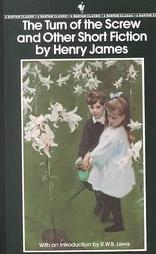 The film, directed by Alejandro Amenabar, resembles one of Henry James's novella, The Turn of the Screw, as both narratives centre around a woman and two children. In James's narrative, the woman is a governess entrusted by a mysterious man to take care of two kids, whereas in The Others, the woman, played by Nicole Kidman, is an actual mother of the two kids, Nicolas and Anne.
If we relate the film to James's narrative, we can see that the film actually goes a bit further than James's narrative that stops short at the death of the boy, Miles, on the lap of the governess and we simply don't know whether the evil is actually real or the work of imagination. Tzvetan Todorov would use this suspension to mark the genre of the fantastic.
However, in The Others, not only the boy dies, but his whole family, including his sister and his mother. But they do not know that they die. It turns out that the whole thing is turned upside down: they are in fact 'the others', whom the living do not want. By resorting to such a supernatural ending, Todorov would call this film the marvellous and lump this film along with other horror flicks and fantasy films like The Adventures of Harry Potter, The Unseeable, and Silent Hill.
If James's narrative is set in the early twentieth century or late nineteenth century, it is because it is the period of social change, when victorianism was being replaced by more modern ways of life and scientific ways of thinking. By contrast, The Others is set during the WWII, and the sense of insecurity and confusion is engendered mainly through a perspective of a family living in the difficult time of war.
Intertext II: The Sixth Sense
 However, to understand The Others fully, we also need to relate to another film, The Sixth Sense (1999), directed by M. Night Shyalaman. Both films have a surprise ending, all having to do with a shift in perspective. Normally it's the ghost that comes to haunt people, to make people scared. But these two films are different in that they're mainly from the point of view of the ghosts themselves, that even the ghosts are in deep trouble, not knowing what or who they are. In The Sixth Sense, it's Doctor Malcolm Crowe who does not realise that he's dead, and in The Others it's the whole family who never learns to accept the truth that they're dead.
It is this ingenious twist that makes the two films interesting. In our postmodern age, we are more ready than ever to be liberal and try to look at things from many perspectives. This time it's the ghost who receives the honour. Both directors interpret the ghosts in an anthropomorphic way, making ghosts resemble humans, the only difference being that they are immaterial. Ghosts still yearn and desire, like humans. They will leave the earth once they can accept the truth that they're dead and learn to let go of their worldly concerns. Quite a Buddhist belief, don't you think?
However, it is my personal belief that both films can be considered to approach the genre of magical realism, in that it signals an attempt to understand the psychology of ghosts and use the framework of the living to grasp the condition of the dead. Perhaps the day will come when we finally take ghosts as a common reality, no longer alienating them by imposing on them some spooky elements like protruding tongues and cold presence. Both The Sixth Sense and The Others can then be read as a critique of horror flicks that try to scare viewers by making ghosts look disgusting and ugly. Ghosts have a heart also, you know, and they can be alienated by us, the living, who try to turn them into well a ghostly presence, neither living nor dead, an in-between that, both Jacques Derrida and Homi Bhabha would argue, terrorises us.
26 November 2006
Metrosexual
One of my students just lent me a Thai film called Metrosexual. Its name in Thai can be roughly translated as The Gang of Gibbons and a Closeted Gay Man. Gibbons in Thai slang mean 'women' for gay people; it's a term of contempt as Thai gays believe that women love to cry out 'phua' most of the time, similar to those gibbons in the jungle. 'Phua' happens to mean 'husband' in Thai and it's not a polite term.
Anyway, let's talk about the film. My first impression is that these five women are loud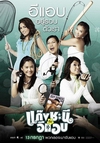 and the world would be a better place without them. Erm ... I'm just joking. I just felt we're now at last able to tackle the issue of sexuality in a frank, funny way. But the film is still predominantly melodramatic -- they tend to overplay emotion and downplay the complexity of gender construction. The messages are very strong and easy to grasp -- friends last longer than lovers; women sometimes marry 'gay' men by accident; and people fall in love happily on Loy Kratong Day. (The last one being just plain awkward and excessive, it simply should be cut from the film.)
However, it does make me wonder. Is being gay something one is born with, or is it constructed by society? Why cannot Kong get married to Pang at the end and reshape his sexuality? Or is it possible that there's this essence of being gay in there waiting to be discovered? And once one 'discovers' (rather than 'invents') this 'true' self, one needs to express it accordingly out of sincerity. I don't think there's an accurate answer to this, but it has long been pestering me. Even though I'd like to be persuaded by the constructivist view of sexuality, that sexuality is something created and categorised by society, somehow I feel a bit ill at ease. Maybe one's gender is shaped by society and this process is too effective and successful, as one feels like gender is something that one imposes upon oneself by choice. Maybe it all starts with an arrangement of DNAs and society further imposes some sort of pigeonholing and stereotyping, creating pattern that imprisons rather than liberates humans.
Anyway, constructivist or not, I believe the film somehow plays upon an all too facile view of sexuality -- that it is something that waits to be discovered, that Kong's gayness is like Pat's gayness or Pee Bee's gayness. The film also suggests that there're also signals that can tell whether one is gay or not. I don't believe this and I think the level of 'gayness' in all 'gay' people is different, to the extent that labelling someone as gay becomes some sort of violence, of putting someone in Jameson's 'prisonhouse of language'. Maybe Kong is what society brands 'gay' but what if he truly loves Pang and wants to settle down together. If so, what Pang's friends do (i.e. asking Kong's male ex-lover to rekindle his homosexual desire) is really terrible. In a way, I somehow wish that Pang and Kong decide to get married in the end, despite the protest of their friends. It's not the question of fooling oneself, but rather it's a question of willing to 'perform' one's gender and stick to it.
I also got a friend who is married to a rather 'gender-dubious' guy. They've been married for years but they are still very much in love. Well, at first our group had a big discussion but at the end we came to a conclusion that it's not the point. The point is whether he really 'loves' her and whether he's willing to share the rest of his life with her. Maybe there're more to life than just labelling and branding ...
Anyway, let's talk about the film. My first impression is that these five women are loud
 and the world would be a better place without them. Erm ... I'm just joking. I just felt we're now at last able to tackle the issue of sexuality in a frank, funny way. But the film is still predominantly melodramatic -- they tend to overplay emotion and downplay the complexity of gender construction. The messages are very strong and easy to grasp -- friends last longer than lovers; women sometimes marry 'gay' men by accident; and people fall in love happily on Loy Kratong Day. (The last one being just plain awkward and excessive, it simply should be cut from the film.)
However, it does make me wonder. Is being gay something one is born with, or is it constructed by society? Why cannot Kong get married to Pang at the end and reshape his sexuality? Or is it possible that there's this essence of being gay in there waiting to be discovered? And once one 'discovers' (rather than 'invents') this 'true' self, one needs to express it accordingly out of sincerity. I don't think there's an accurate answer to this, but it has long been pestering me. Even though I'd like to be persuaded by the constructivist view of sexuality, that sexuality is something created and categorised by society, somehow I feel a bit ill at ease. Maybe one's gender is shaped by society and this process is too effective and successful, as one feels like gender is something that one imposes upon oneself by choice. Maybe it all starts with an arrangement of DNAs and society further imposes some sort of pigeonholing and stereotyping, creating pattern that imprisons rather than liberates humans.
Anyway, constructivist or not, I believe the film somehow plays upon an all too facile view of sexuality -- that it is something that waits to be discovered, that Kong's gayness is like Pat's gayness or Pee Bee's gayness. The film also suggests that there're also signals that can tell whether one is gay or not. I don't believe this and I think the level of 'gayness' in all 'gay' people is different, to the extent that labelling someone as gay becomes some sort of violence, of putting someone in Jameson's 'prisonhouse of language'. Maybe Kong is what society brands 'gay' but what if he truly loves Pang and wants to settle down together. If so, what Pang's friends do (i.e. asking Kong's male ex-lover to rekindle his homosexual desire) is really terrible. In a way, I somehow wish that Pang and Kong decide to get married in the end, despite the protest of their friends. It's not the question of fooling oneself, but rather it's a question of willing to 'perform' one's gender and stick to it.
I also got a friend who is married to a rather 'gender-dubious' guy. They've been married for years but they are still very much in love. Well, at first our group had a big discussion but at the end we came to a conclusion that it's not the point. The point is whether he really 'loves' her and whether he's willing to share the rest of his life with her. Maybe there're more to life than just labelling and branding ...
06 November 2006
Cafe Lumiere
I know I should have had updated this sooner during the school holiday. But hey I got life you know. On my birthday this year Mat took me (of course it's originally my idea) to the Siam Ocean World to see weird fish and a fake polar bear. It's such a pleasant experience to leave books once in a while and do something else. Well, books might be the world but the world does not only comprise books. Bookworms beware! Saying that, I'm hooked on Garcia Marquez's Erendira story at the moment. Such a contradictory man I am.
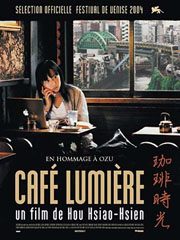
Right, today I'm going to talk about the Japanese film Cafe Lumiere, which I saw long time ago but the feeling still somewhat lingers. It's nice to watch a 'silent' film once in a while, especially if you happen to live in one of the maddest cities in the world, littered with noise everywhere. Tops supermarkets for instance install this terrible advert thing -- if someone walks past this machine, it'll be activated to switch on and emit noise selling all sort of products from whitening face masks to cockroach baits. On top of that, they even play Tops radio in the background (sometimes so loud that I couldn't hear myself think!). I reckon people at Tops don't want customers to make a good judgement on what to buy and what not, but to be lured by their price gimmicks and display tactics.
Anyway, let's talk about the film. When I say it's a 'silent' film, I don't mean that the actors don't talk or become some sort of mute people. They do talk but they choose not to (maybe they've been living in Bangkok before moving back to Japan). It's 'almost a love story' between Yoko and Hajime, 'almost a love story' because you only 'feel' that the two are in love but there's no physical evidence of whatever kind in the film that tells you straightaway that they're so in love. They don't kiss; they don't hug, so don't even bother imagining that they'll have sex on the train like some Japanese porns. They just talk and sometimes they remain quiet -- just like that, side by side, in a second-hand bookshop run by Hajime, who happens to be handsome -- but somehow you can feel that there's kind of warmth and understanding emanating from their co-presence.
There's also another kind of quiet -- that between Yoko and her parents, especially her reticent Dad. Yoko is pregnant with someone else and her Dad does nothing but remain silent throughout. You can just tell that there's some sort of reproachful tone in his silence (pardon my use of paradox here).
The film ends abruptly, without letting people know that the two will live happily ever after. When I watched it, I was quite surprised at such a sudden end and thought that there's something wrong with the DVD. But then I bought it from a proper shop in Central World, not from a Silom stall, so it should be all right. It's just my mindset that's the problem. So I started to readjust my frame, realising that maybe the end is meant to be like that -- quick, abrupt, but powerful. Powerful in the sense that maybe life is like that: no one will know how people's lives will end and it can be quite precocious to presume. Maybe when two lives converge, it's like two trains passing each other. Just like that. A fond memory. Something that doesn't last but somehow lingers. No wonder why Hajime likes to record 'the sound of the trains': to take this metaphorically, perhaps Hajime can be compared to a film producer who tries to capture the rhythm of contemporary urban lifestyle in the changing Tokyo landscape. Oh such a metafictional subtext. Traditional narrative forms may no longer be appropriate -- no fairy-tale ending, no magical stardust turning an ugly pauper into a handsome prince. But it's good that it still keeps one traditional element intact -- love. Even though I didn't recall hearing the word uttered in the film, I got the feeling that the film wants us to realise that it's not easy living in a big city like Tokyo, but if there's someone there with you life will at least be easier.
Gosh, it's the first time in this weblog that I don't express any anger or annoyance at the end. How rare!
08 October 2006
The Rule of Four
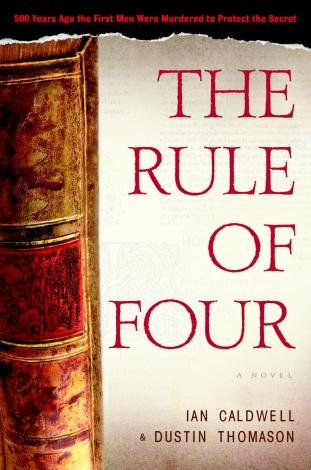
I've just finished The Rule of Four, a debut novel by Caldwell and Thomason. I must say I find it pretty disappointing towards the end as there are some knots that are yet to be untied. It seems like the authors prefer to give emphasis to thriller elements and the melodramatic ending (a fire!) at the expense of intellectual decoding. For example, I don't know where the crypt really is at the end or what Paul does to the blueprint. These should be two of the most important moments when the authors can add more fun in enticing the readers with more codes to be cracked. Yet these two moments simply vanish from the narrative, leaving the reader to pick up pieces at the end finding Paul already lurking in the crypt in Italy! I find Dan Brown's works better in this aspect, as he never leaves the reader gasping at narrative gaps. All of Brown's knots are duly untied at the end.
However, the psychological complexities of the characters are pretty good, even though I know of some readers who reject these or find them irrelevant. Good thrillers can show some psychological aspects of the characters too and I think the relationship of the main characters are reasonably good. I personally find that between Tom and Katie realistic and not totally irrelevant. But I wonder whether choosing Tom's point of view would eventually compromise the narrative, as towards the end it is PAUL who cracks the two most important puzzles and the reader is sadly kept at a distance.
Subscribe to:
Posts (Atom)